
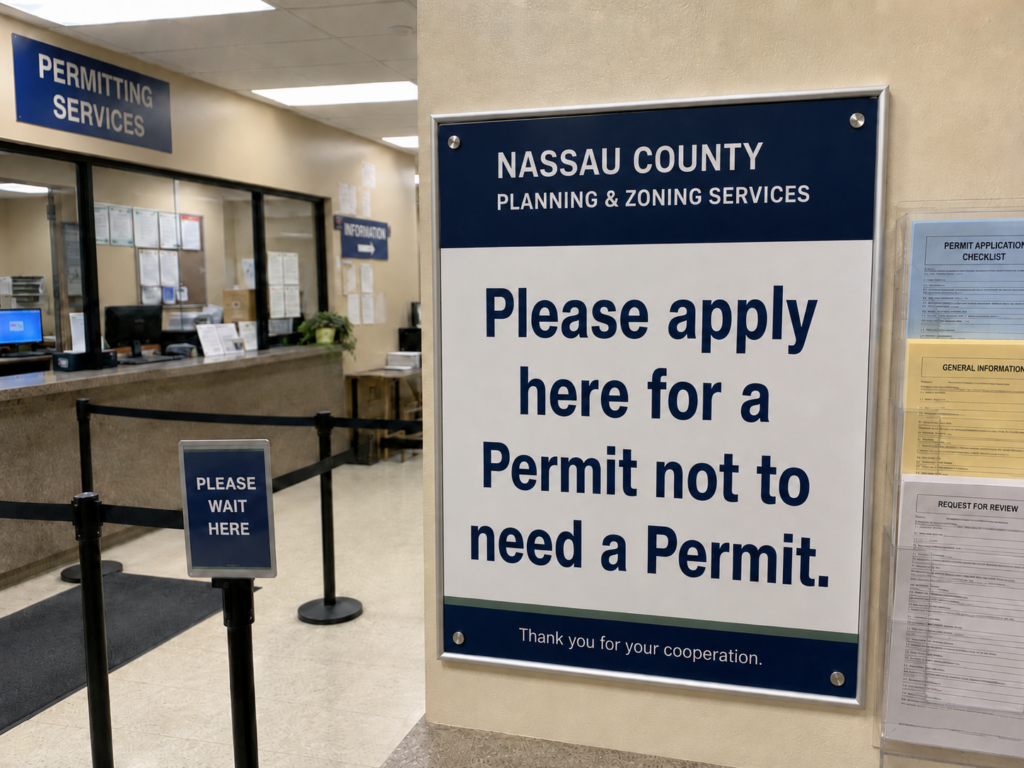
Florida House Bill 803 was intended to make life easier for homeowners by exempting certain small residential projects from building-permit requirements. Nassau County’s implementation, however, offers a nearly perfect example of how government can turn regulatory relief into another government process.
The county’s new bulletin explains that qualifying nonstructural work valued at less than $7,500 may no longer require a building permit. That sounds like welcome news—until the next sentence.
Before beginning the work, owners and contractors must submit a Building Permit Exemption Request and obtain approval from the county’s Building Official.
In other words:
You do not need a permit, but you must apply to the permitting department for permission not to need one.
“No Permit” Comes With Plenty of Paperwork
To qualify for this permit exemption, an applicant must provide information about the property, the owner, the contractor, the scope of the work, the project cost and the square footage affected.
A written contract or other documentation describing the work is required. For certain projects, additional materials may include contractor-license documentation, a flood-zone map and a site plan or diagram. The signatures must also be notarized.
Once approved, the stamped exemption paperwork must remain at the jobsite throughout construction and be available for review by Code Enforcement. Failure to keep the approved paperwork onsite may result in a Stop Work Order.
So the project may be “permit exempt,” but it is certainly not paperwork exempt, approval exempt or enforcement exempt.
The government has apparently removed the permit while preserving much of the permit process.
Even FDEP Has Found a Simpler Way
The Florida Department of Environmental Protection—quite possibly one of the most bureaucratic agencies ever invented—already uses a self-certification process for smaller drainage projects.
The applicant fills out a form describing the project, certifies that it meets the exemption requirements and attaches any supporting drawings or calculations. The process is automated, and the permit is issued immediately.
Think about that: FDEP has found a way to protect the public interest without forcing applicants through a lengthy review and approval process.
If FDEP can do it, why can’t Nassau County?
The Flood-Barrier Exemption That Excludes Flood-Hazard Properties
HB 803 also provides an exemption for certain temporary flood barriers intended to prevent flooding or storm surge from entering a home.
But there is a catch: Properties located wholly or partially within a designated Special Flood Hazard Area do not qualify for the exemption.
That creates another obvious irony:
The flood-barrier exemption is unavailable to many of the homeowners officially considered most vulnerable to flooding.
Those outside designated flood-hazard areas may qualify for streamlined treatment when installing temporary flood protection. Those inside the higher-risk areas must continue through the regular permitting process.
That limitation may originate in the state legislation, but Nassau County residents are the ones who must navigate it.
The County Controls the Process—but Accepts No Responsibility
Perhaps the greatest contradiction appears in the county’s legal disclaimer.
The county requires the exemption request to be submitted and accepted. The Building Official stamps the paperwork. Code Enforcement may demand to see it onsite. The county may even issue a Stop Work Order if the approved documents are not present.
But after exercising that authority, Nassau County declares that it owes the property owner and contractor “no legal duty whatsoever” regarding the exempt work.
The county also disclaims liability for structural failure, property damage, personal injury, flooding or other harm. Its approval does not represent an inspection or endorsement of the work’s quality, safety or code compliance.
Translated into everyday language:
The county wants the authority to approve the exemption, control the paperwork and stop the project—but none of the responsibility for what it approved.
The homeowner and contractor remain fully responsible for complying with every applicable building code, ordinance, regulation and law—even though the county will not inspect the work.
DOGE Question: Is This Really Regulatory Relief?
The purpose of a permit exemption should be simple: Remove unnecessary government involvement from small, low-risk projects.
Instead, residents are being directed into a new administrative system involving an application, attachments, official acceptance, notarization, stamped paperwork, onsite-document requirements and the continuing possibility of enforcement action.
NassauFLDOGE supports reasonable safety standards. But government should not advertise regulatory relief while quietly rebuilding the regulation under another name.
DOGE Solution
Follow the model already used by FDEP for smaller drainage projects. Create a simple, automated online self-certification process for qualifying work. Let the owner or contractor describe the project, certify that it meets the statutory exemption requirements, attach any necessary drawings or calculations and receive an immediate confirmation number. Reserve county enforcement for fraud, unsafe work or projects that clearly fall outside the exemption.
No lengthy approval process. No unnecessary notarization. No pretending that an exemption request is fundamentally different from a permit application.
Because at the moment, the only thing truly exempt from Nassau County’s permit process appears to be the word “permit.”