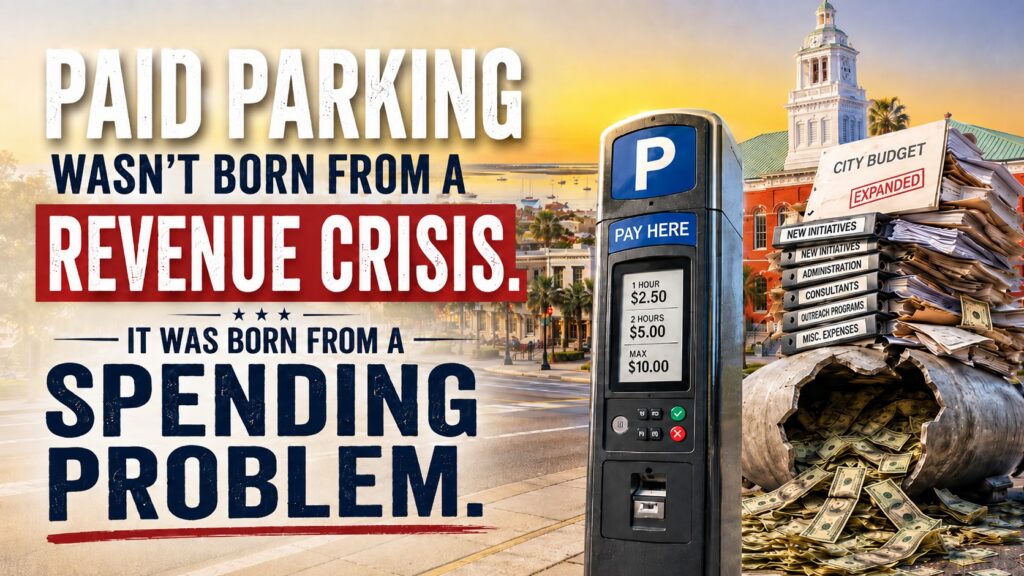
A recent Fernandina Observer commentary argues that decisions by previous City Commissioners created the financial pressures that eventually led to paid parking.
We see it differently.
Fernandina Beach does not have nearly as much of a revenue problem as it has a spending, priority and management problem.
Government always has another choice before asking taxpayers for more money:
Spend less. Prioritize better. Operate more efficiently.
The Observer’s own numbers help make that case. It reports that the municipal golf course was budgeted to receive an $890,000 subsidy and the marina another $686,000 transfer from the General Fund.
That is nearly $1.6 million supporting just two City-owned operations.
Before creating paid parking, raising taxes or imposing additional fees, shouldn’t taxpayers be asking why City business operations require that level of support?
Can they become self-sustaining? Should they be contracted, leased or sold? Could City-owned properties be returned to private ownership and the tax rolls?
Those questions deserve answers.
Look at Recent Spending Decisions
The current City Commission also made its own expensive choices.
The City approved approximately $2.1 million to purchase downtown waterfront property, including an aging warehouse, for possible future City use.
That property could instead have remained in private hands, been redeveloped and contributed to the tax base.
The City has also committed millions to Waterfront Park, including another $700,000 for additional improvements.
Again, those were choices.
When government spends millions on discretionary projects and then says it needs more revenue, taxpayers have every right to question the priorities.
Why Is Revenue Always the Answer?
Every financial problem seems to lead to the same discussion:
More revenue. Higher fees. Higher taxes. Paid parking.
But where is the equally serious conversation about reducing expenses?
Where is the discussion about reducing staffing through normal attrition, reviewing compensation and benefits, examining outside contracts and requiring City enterprises to operate more like actual businesses?
Look at lengthy projects such as the Ash Street construction around City Hall.
Is the answer always more revenue?
Or should we also be asking whether projects are being managed efficiently and whether taxpayers are getting value for their money?
More money does not automatically solve poor management.
This Commission Made the Paid Parking Decision
Whatever decisions previous commissions made, the current commission chose paid parking.
The previous commission did not cast those votes.
The citizens then responded overwhelmingly and rejected the idea.
Trying to blame today’s unpopular decision on elected officials from years ago misses the larger point.
At some point, elected officials have to own the decisions they make.
Arithmetic Has Two Sides
The Observer is right that arithmetic matters.
But arithmetic has two sides.
Revenue is one. Spending is the other.
Instead of asking, “Where will we find the revenue to replace paid parking?” City leaders should first ask:
“What spending can we eliminate, postpone, restructure or operate more efficiently?”
Review enterprise subsidies.
Review staffing.
Review City-owned property.
Review contracts and litigation expenses.
Prioritize essential infrastructure over wish-list projects.
And stop assuming every financial problem requires another dollar from citizens.
Fernandina Beach may not need another revenue stream.
It may simply need better spending decisions and stronger leadership.
That’s our opinion. The numbers are there for everyone to see.