

Before you vote on November 3, find out how much you’ve already paid!
Did you know Nassau County property owners already pay taxes to support our public schools?
Of course they do! School taxes are already part of our annual property tax bills.
But here’s what some taxpayers may not realize.
On November 3, you’re being asked whether to continue paying an ADDITIONAL school property tax, over and above the regular school taxes you already pay.
It’s called the School Millage Referendum, and it’s worth understanding before you head to the polls.
Wait! Aren’t We Already Paying This Additional Tax?
Yes, we are!
Nassau County voters approved this additional one-mill tax in 2022. That authorization expires at the end of 2026.
Now the School District is asking voters to renew it for another four years — 2027 through 2030.
This is not a proposal to increase the existing one-mill rate. It is a proposal to continue collecting a tax that would otherwise expire.
Here is the important distinction:
- Vote YES: The additional one-mill school tax continues for four more years, alongside regular school taxes.
- Vote NO: The additional one-mill tax authorization expires at the end of 2026. Regular school property taxes continue.
In other words, this vote isn’t about whether to fund our public schools. They already receive funding through regular school taxes and other sources.
It’s about whether to continue this additional funding.
So How Much Is One Mill?
Let’s put it in dollars we can understand.
One mill is $1 in taxes for every $1,000 of taxable property value.
Here’s what that means if your taxable value stays the same:
| Taxable Property Value | Additional Tax Each Year | Total Over Four Years |
| $200,000 | $200 | $800 |
| $300,000 | $300 | $1,200 |
| $400,000 | $400 | $1,600 |
| $500,000 | $500 | $2,000 |
And remember, these amounts are in addition to your regular school property taxes, not your total school tax bill.
Your actual payments can change as taxable values change.
Here’s Something Kevin Lilly Wants Taxpayers to See!
I recently had a conversation with Nassau County Property Appraiser Kevin Lilly, who walked me through some very interesting property tax information.
One of the most useful things his office has developed is an interactive dashboard showing what the existing one-mill school tax means for individual properties.
And this is where NassauFLDOGE wants you to do a little homework!
Instead of looking at averages or estimates, you can look up your own property and see the figures for 2023 through 2026.
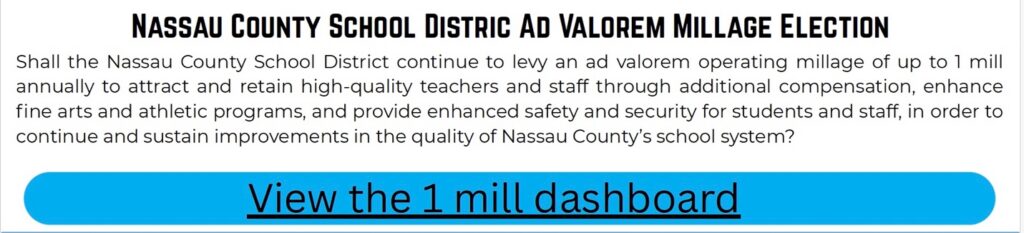
CLICK HERE TO SEE WHAT YOU’VE PAID
Take a few minutes to find your property. Look at the numbers. Add them up.
That’s money you’ve been paying in addition to the regular school taxes on your property.
Where Does This Additional Money Go?
According to the Nassau County School District, the additional one-mill revenue supports:
- Additional compensation to recruit and retain teachers and staff.
- School safety and security improvements.
- Fine arts programs.
- Athletic programs.
The School District says approximately 70% of the revenue has gone toward employee compensation, 12% toward school safety, and the remainder toward arts and athletics.
Those are the District’s reported uses of the funding. Taxpayers can also review its budgets and financial reports to understand the expenditures behind those figures.
And What About Amendment 3?
Here’s another important distinction.
Amendment 3 is also on the November ballot and proposes increasing Florida’s homestead exemption for non-school property taxes.
However, Amendment 3 does not eliminate regular school property taxes or this additional one-mill school tax.
The School Millage Referendum is a separate ballot question.
So regardless of what happens with Amendment 3, Nassau voters must independently decide whether the additional school millage continues.
Before You Vote, Look at Your Own Numbers!
We appreciate Kevin Lilly and his team for making this information available to Nassau property owners.
The Property Appraiser’s Office does not take positions on ballot measures. Its role is to provide taxpayers with factual information, and this dashboard is a useful resource.
At NassauFLDOGE, our mission is transparency, accountability, and helping residents understand where their tax dollars go.
Whether you’re reviewing the School District’s funding priorities or looking at your own property tax bill, the numbers matter.
So before November 3, spend a few minutes with Kevin’s dashboard.
You already pay regular school property taxes. Now you have an opportunity to see what this additional tax has cost you — and what its continuation would mean for the next four years.
That’s information every Nassau County taxpayer should have before casting a vote.
For more information, visit NassauFLDOGE.com and the Nassau County Property Appraiser’s website.